
Key takeaways
- The Problem: Utilities and grid operators inspect transmission lines, towers and substations through tower climbs, ground patrols and walk-downs in live yards. The work is slow, puts crews at height and near energised equipment, and often needs an outage window that takes capacity off the network.
- The Solution: Drone-based visual and thermal inspection of towers, conductors, insulators, rights of way and substations, with AI-flagged defects mapped to each structure and delivered as a prioritised report.
- The ROI: 80% reduction in inspection cost, fewer tower climbs, and maintenance planned from condition data, so outage windows are booked for repairs rather than for looking.
The Challenge: Inspecting the Grid Without Taking It Down
Transmission networks run for hundreds of kilometres across farmland, forest and hills. Every structure needs checking on a cycle, and most defects that cause trips are small: a cracked insulator, a missing bolt, a hot connector, a tree growing towards the conductor.
Traditional methods struggle to find them:
- Tower climbs put line crews at height for every inspection and often need the circuit switched out first, which means an outage request, planning lead time and lost transmission capacity
- Ground patrols view hardware from below through binoculars, so defects on the far side or top of the structure are easy to miss
- Helicopter patrols cover distance quickly but are costly and produce imagery that is hard to tie to a specific tower
- Substation walk-downs require staff to move through energised yards, and handheld thermal checks only cover what one person can reach in a shift
The result is patchy data that is hard to compare between cycles and expensive to collect.
The YelloSKYE Solution for Transmission and Substation Inspection
YelloSKYE flies drones with high-resolution RGB and radiometric thermal sensors along transmission corridors and over substations, analysed through Inspect IQ. Crews stay on the ground and every image is tied to a tower number and GPS position.
- Tower and hardware condition: Close-range imagery of each structure picks up cracked insulators, missing or loose hardware, corrosion on steelwork and damaged fittings, from angles a ground patrol cannot reach.
- Conductor and connection thermal checks: Thermal imaging highlights hot joints, clamps and connectors, which are early signs of a failing connection.
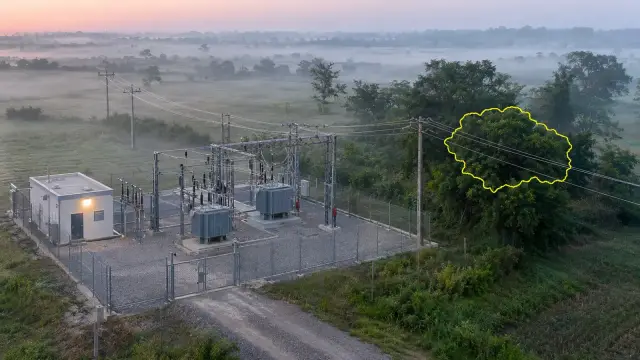
- Vegetation encroachment: Repeat corridor flights show where trees and scrub are growing towards conductors, so clearance crews go to the spans that need them rather than cutting on a fixed rota.
- Substation thermal audits: Thermal surveys of transformers, switchgear, busbars and disconnectors flag hotspots without staff entering energised areas.
- Construction and as-built records: New lines and substations are captured during the build with drone surveys at ±2–3 cm accuracy, giving the owner a verified baseline before energisation.
Solar plants connected to the network can be covered in the same programme. The panel-level workflow is set out in our solar farm thermal inspection use case.
How a Grid Inspection Programme Runs
| Stage | What happens | Output |
|---|---|---|
| Plan | Corridors, tower lists and substations are agreed with the asset owner, and flights are planned around access and airspace | Flight plan per circuit |
| Capture | Drones fly each structure and span with RGB and thermal sensors | Geotagged imagery per tower |
| Analyse | AI flags defects and thermal anomalies, and engineers review and grade them | Defect register by structure |
| Report | Findings are ranked by severity and mapped to tower numbers | Prioritised maintenance list within 48–72 hours |
Long corridor flights may need beyond visual line of sight approval from the national aviation authority (for example the FAA in the US, the CAA in the UK or the GCAA in the UAE).
Why Utilities Are Moving to Drone Inspection
- Fewer climbs and fewer outages: Visual and thermal checks are carried out with the line in service, so outage windows are kept for the repairs the data justifies.
- Defects found earlier: Thermal anomalies and hardware damage are caught before they lead to a trip or a fault.
- Comparable records: Capturing the same structures on each cycle builds a condition history per tower, which supports asset management planning and regulatory reporting.
The Impact
Grid operators move from periodic manual checks to a structured record for every tower and substation. Inspection cost falls by up to 80%, crews spend less time at height, and maintenance teams receive a defect list they can act on within 48–72 hours of capture.
The same approach extends to the rest of the estate, from rooftops and facades to industrial structures, as covered in our automated asset inspection use case.
Who This Is For
- Transmission system operators managing high-voltage lines and towers
- Distribution network operators with large overhead networks
- Substation owners and O&M contractors responsible for yard condition
- Renewable generators with grid connections and private substations
Book a demo to see how YelloSKYE makes transmission and substation inspection safer and faster for utilities and grid operators.