
Key takeaways
- The Question: What can ground inspection robots actually do on oil and gas plants and solar farms, what stops them, and how should an operator decide whether one is worth trialling?
- The Answer: Inspection robots are best at repetitive rounds in the same places: reading gauges, photographing equipment, listening for unusual noise, checking temperatures and sniffing for gas, often in areas where people would rather not spend time. They struggle with stairs, weather, battery life, hazardous-area rules and messy data handling. A pilot on one well-defined round, with the data path agreed in advance, is the sensible way to find out.
- The YelloSKYE Angle: YelloSKYE does not build or operate ground robots. Inspect IQ covers the views a robot cannot reach, such as stacks, tall structures and whole solar arrays from the air, and fixed cameras on DEX watch the points that need continuous attention.
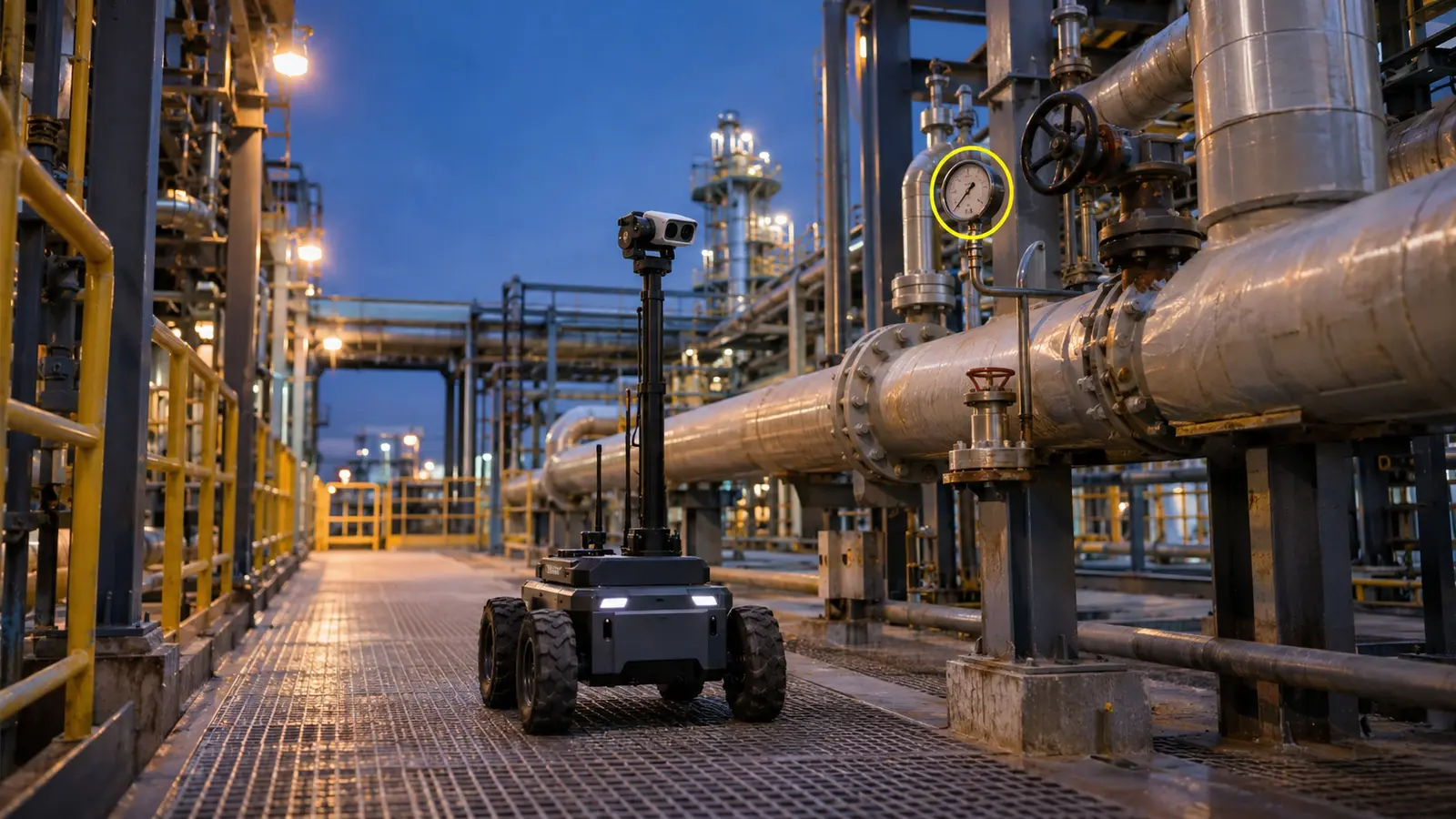
Industrial inspection robots are mobile machines that carry cameras and sensors around a plant, on a planned route, to collect the readings and images that operators and inspectors would otherwise gather on foot. On oil and gas facilities they take on routine rounds and visual checks in hazardous or remote areas; on solar farms they work along the rows recording module details and condition. Their value is consistency and reduced time for people in harm's way, not a replacement for engineering judgement.
YelloSKYE does not supply robots. Our work is aerial and fixed-camera inspection through Inspect IQ, and this guide is written for operators deciding where a ground robot fits alongside drones, fixed cameras and people. For robots on building sites rather than operating plants, see our guide to construction robotics.
What counts as an industrial inspection robot
"Inspection robot" covers several quite different machines. The choice depends mainly on the ground they have to cover.
| Robot type | Where it works best | Strengths | Limits |
|---|---|---|---|
| Legged (four-legged) | Process plant with stairs, kerbs, grating and uneven ground | Climbs stairs, steps over obstacles, reaches most places a person walks | Shorter battery life, higher cost, sensitive to slippery surfaces |
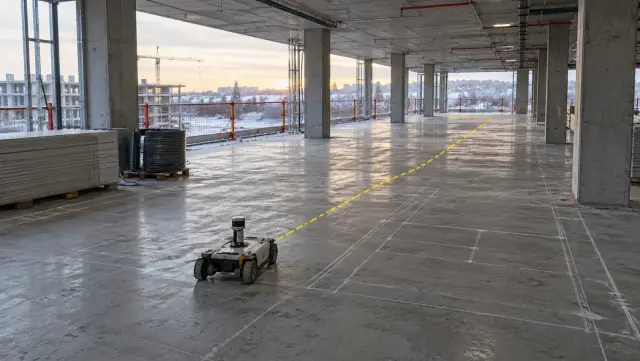
| Wheeled or tracked | Flat plant areas, substations, solar rows, warehouses | Longer range, heavier payloads, simpler to maintain | Stopped by stairs and high kerbs, struggles in mud or snow |
| Rail or cable-mounted | Conveyors, tunnels, long pipe galleries, enclosed halls | Very repeatable path, continuous operation, easy charging | Only covers the line it is fixed to |
| Magnetic crawler | Tank walls, vessels, steel structures | Close contact for thickness and weld checks | Slow, needs a clean steel surface, short reach |
| In-pipe crawler | Inside pipelines, ducts and sewers | Sees the inside of assets nobody can enter | Needs access points and often a shutdown |
Most of this guide is about the first two groups, because they are the ones operators are now deploying for general rounds across a site.
The jobs robots are given
Operator rounds
Every process plant has rounds: a fixed walk to read pressure and temperature gauges, check levels in sight glasses, confirm valve positions and look for leaks, drips and anything out of place. Rounds are essential, repetitive and often done in noisy, hot areas. A robot can follow the same route several times a shift, photograph every gauge from the same position and convert analogue readings to numbers using image recognition. Readings outside set limits are flagged for an operator to check.
Thermal, acoustic and gas checks
A thermal camera on the mast can scan motors, bearings, pumps, electrical panels and insulated lines for unusual heat. A microphone array can listen for compressed-air and gas leaks or a change in the sound of rotating equipment. A gas detector can log concentrations along the route. None of these replace fixed gas detection or condition monitoring systems; they add a mobile check between them.
Visual inspection in hazardous areas
Many regulators require periodic visual inspection of electrical equipment installed in hazardous areas, to confirm that enclosures, glands and seals are intact. These checks are frequent, time-consuming and mostly a matter of looking closely at a large number of items. A robot that photographs each item from a known position gives inspectors a set of images to review at a desk, so their site time goes on the items that actually need attention.
Solar plants
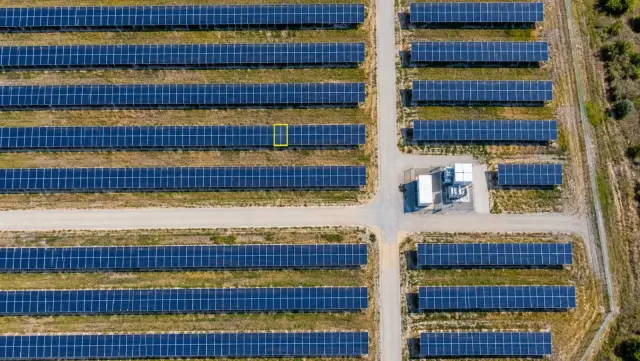
Large solar farms hold hundreds of thousands of modules, and owners need to know which module, with which serial number, is in which position, both for warranty claims and for tracking degradation. Recording that by hand means long days walking rows in heat and glare. Wheeled robots with cameras can drive the rows, read module labels and record their positions, then return later to photograph specific modules when a fault or a warranty question comes up. Aerial thermal surveys remain the faster way to find faulty modules across a whole plant; our guide to solar farm drone inspection covers that side.
Remote and unmanned sites
For well pads, compressor stations, pumping sites and substations that are normally unmanned, a robot kept on site in a weatherproof dock can carry out checks without someone driving hours to get there. When an alarm comes in, an operator can drive the robot remotely to look before deciding whether to send a crew.
Working in hazardous areas
Hazardous-area rules are the biggest practical constraint on robots in oil and gas. Plants are divided into zones by the likelihood of a flammable atmosphere, and any electrical equipment entering a zone must be suitable for it. Rules differ by country. In Europe, equipment for explosive atmospheres falls under the ATEX directives; the IECEx scheme is used internationally; other countries have their own systems.
In practice, operators take one of three routes:
- Certified robots designed for the zone they enter, which is the cleanest route but limits the choice of machine.
- Controlled use of non-certified robots under the site's permit-to-work system, with gas detection on board and an automatic shutdown that isolates the battery if gas is detected. Whether this is acceptable is a decision for the site's own safety authority, not the robot supplier.
- Restricting robots to non-classified areas and using other methods inside the zones.
Whichever route is taken, robots need a place in the site's emergency procedures: what happens to the robot during an alarm, how it is recovered if it fails in a zone, and who is allowed to send it where.
Autonomy, missions and connectivity
Most industrial robots are taught a route once, by being driven around it, and then repeat it on a schedule. At each waypoint the mission defines an action: photograph this gauge, take a thermal image of that motor, record sound for ten seconds. Good systems store the mission on the robot itself so it can complete a round without a constant network connection, which matters in plants where wireless coverage is patchy. Remote control is kept for investigations and recovery.
Autonomy changes the economics. A robot that needs someone to drive it saves exposure time but not much labour; a robot that runs its round alone, docks and charges itself, and sends only the exceptions to a person saves both.
Where the data goes
The weak point of many robot pilots is not the robot but the data. Thousands of images per day are of little use if nobody can find the one that matters.
Before the first mission, agree:
- Asset IDs. Every waypoint should be tied to an item in the asset register, so a reading or image arrives already labelled with the equipment it belongs to.
- Thresholds. Which readings trigger an alert, and to whom.
- Destination. Whether results flow into the maintenance management system, a historian, a digital twin or an inspection database, and in what format.
- Review. Who checks flagged items, how quickly, and how a confirmed defect becomes a work order.
- Retention. How long images are kept, which matters for regulated inspections where the record is evidence.
Robots, drones and fixed cameras compared
Robots are one of several ways to capture a plant's condition without sending a person each time. Each covers a different part of the site.
| Need | Ground robot | Drone | Fixed camera |
|---|---|---|---|
| Gauges, valves and equipment at eye level inside congested plant | Strong | Weak, access is difficult | Good for a few chosen points |
| Stacks, flares, tall structures, roofs | Cannot reach | Strong | Limited views |
| Whole-site overview, large solar arrays | Slow | Strong | Weak |
| Frequent repeated rounds, several per day | Strong | Possible, limited by flight rules | Continuous at fixed points |
| Indoor halls and enclosed modules | Strong | Possible with care | Strong at fixed points |
| Continuous watch on one critical area | Weak | Weak | Strong |
From the air, Inspect IQ checks tall stacks for thermal anomalies, spalled concrete and surface corrosion while the aircraft keeps its distance, so no scaffolding goes up. In YelloSKYE's automated asset inspection work, drones carry RGB, thermal and LiDAR payloads at once along pre-programmed paths, and the data is processed into a 3D model in which each finding has its GPS position. On arrays, the solar farm thermal inspection work applies the same approach, with a stated 75 per cent cut in inspection cost compared with ground teams walking the rows. For continuous views, the fixed-camera monitoring use case covers cameras on industrial facilities feeding a dated, round-the-clock visual record into DEX. Our guide to oil and gas drone inspection covers the aerial methods asset by asset.
Building the business case
The case for a robot usually rests on four things: fewer hours for people in hazardous or remote areas, less travel to unmanned sites, more frequent and more consistent data than manual rounds produce, and staff time moved from collecting data to analysing it.
Count the costs honestly. They include the robot and its sensors, docking and charging stations, hazardous-area certification or the engineering needed to use the robot safely, wireless coverage, integration with existing systems, physical changes such as ramps or wider walkways, maintenance and spare parts, and the people who plan missions and review results. Change management is a cost too: operators need to trust the robot's data, and representatives of the workforce should be involved early.
Limits worth planning for
- Terrain. Steep ladders, narrow gaps, wet grating, ice and deep mud defeat many machines.
- Weather and environment. Heavy rain, dust, extreme heat and cold shorten battery life and affect sensors.
- Endurance. A round that takes a person two hours may need a robot to stop and recharge.
- Manipulation. Most inspection robots look and listen; few can open a valve, clean a gauge or remove a cover.
- Change on site. Scaffolding, temporary equipment and maintenance work block taught routes, so missions need regular review.
- Data overload. Without thresholds and asset IDs, robots produce far more images than anyone can read.
Running a pilot: checklist
- Choose one round that is repetitive, well defined and done in an uncomfortable or remote place.
- Record the current method: time taken, frequency, data quality and exposure hours.
- Check the route physically for stairs, gaps, surfaces, lighting and wireless coverage.
- Settle the hazardous-area approach with the site's safety authority before the robot arrives.
- Tie every waypoint to an asset ID and agree thresholds and alert recipients.
- Decide where the data goes and who reviews it, with a target time from round to review.
- Run the pilot for a fixed period and compare completion rate, data quality and hours saved with the baseline.
- Map the gaps the robot cannot cover, such as heights and wide areas, and decide how drones, fixed cameras or people will fill them.