
Key takeaways
- The Problem: Relying on fragmented progress reports and manual site visits creates massive coordination delays and subjective handovers during complex interior fit-outs.
- The Solution: Deploying 360° visual intelligence to create navigable, time-stamped digital twins of the interior space.
- The ROI: 70% reduction in coordination time, instant remote verification for stakeholders, and zero ambiguity during contractor handovers.
For real estate developers and project management consultants, managing site progress is still difficult. The structural phase of a building is massive, but it is the interior fit-out phase where complexity truly multiplies.
Today, construction sites generate thousands of photos, but almost no usable data. The industry is now demanding automation, visibility, and data-led execution. Yet, the way interior progress is tracked has remained stuck in the past. It is time to shift from fragmented updates to verifiable visual intelligence.
The Execution Gap: Why Manual Reports Are Failing Leadership
Typical project workflows today rely heavily on manual processes. Site teams capture photos on their phones, share those images on WhatsApp or emails, and eventually compile manual reports.
By the time this information reaches the boardroom, it is merely an interpretation of the site, not the reality. Because of this fragmented workflow, leadership lacks real-time visibility. This results in a compounding list of blind spots:
- No spatial context: Photos are isolated snapshots, making it impossible to understand exactly where an issue is located.
- No timeline comparison: Stakeholders cannot easily compare what the site looked like last week versus today.
- No structured documentation: There is a lack of a permanent visual history.
"Ultimately, this lack of clarity leads to slow decision-making. When teams cannot agree on the actual ground reality, coordination time balloons and handover schedules slip."
The Shift: What If Every Site Walk Became Structured Data?
The solution isn't capturing more photos; it is changing how visual data is captured and consumed. The shift happens when a simple walkthrough captures the interiors exactly as they exist.
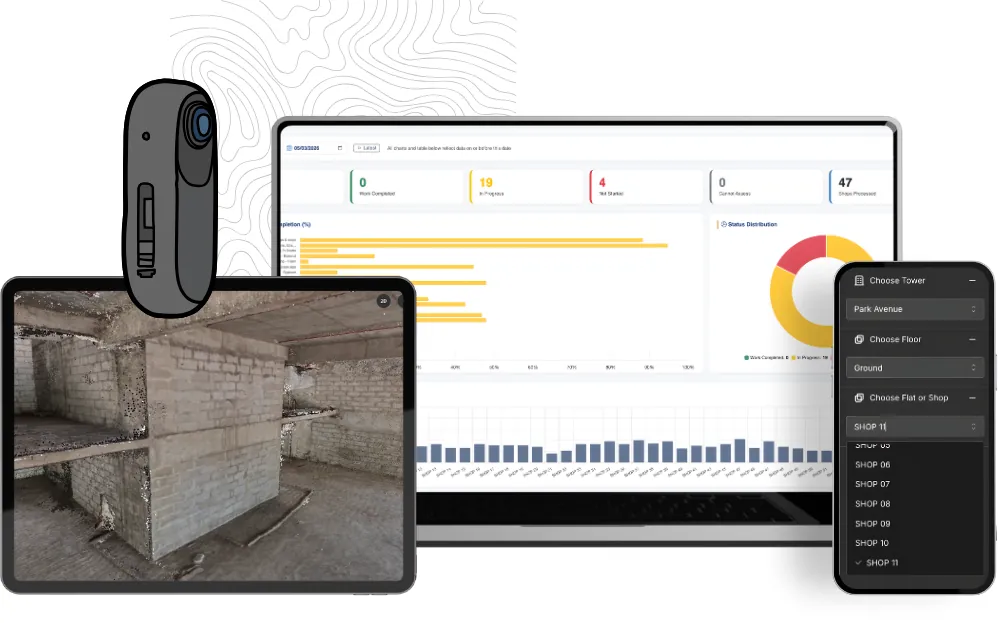
Using Interior 360 Intelligence, a site team member simply walks through the interiors with a 360° capture device. There is zero technician dependency—it can be operated by any site worker. From there, AI reconstructs the space. The 360° imagery is converted into a spatial, navigable visual twin of the interiors.
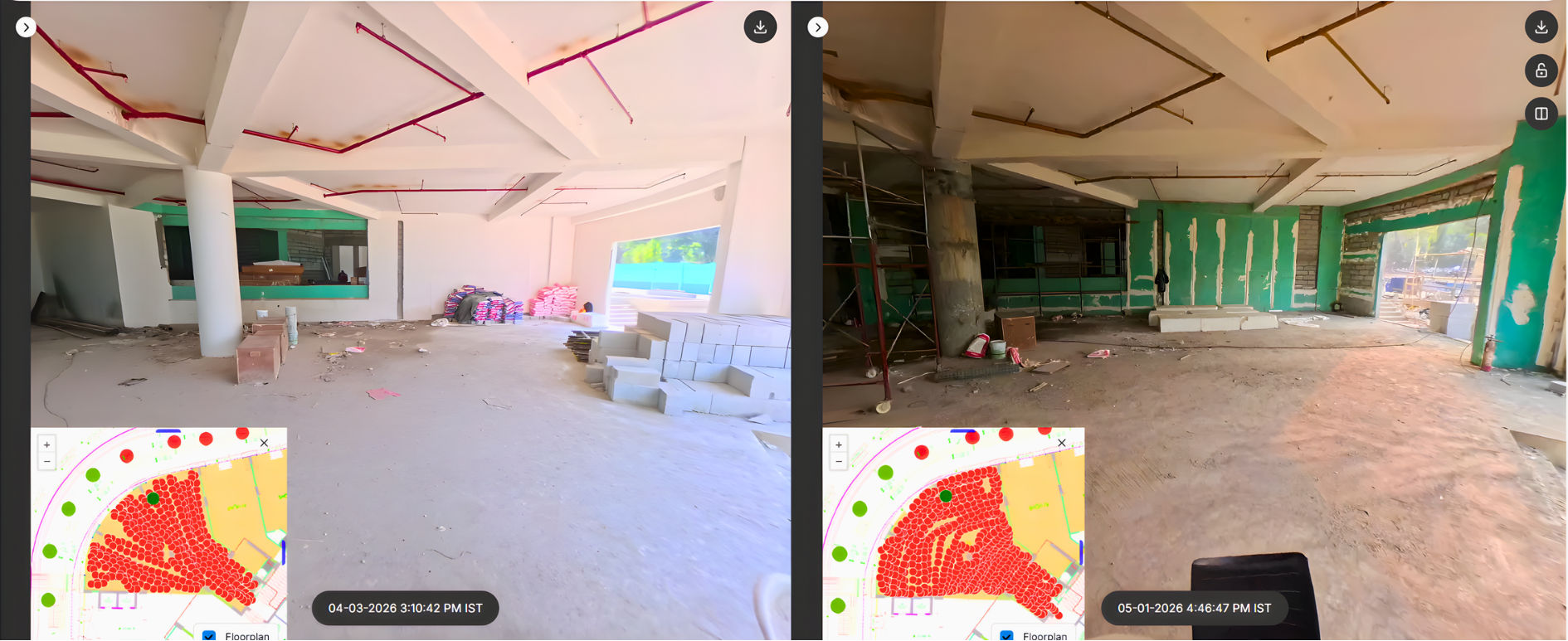
How Visual Ground Truth Accelerates Project Execution
When you transition from scattered photos to an accurate interior digital twin, you empower your entire team with actionable interior insights. Here is how leading developers are leveraging this intelligence:
1. Time Travel and Progress Tracking
Move across different capture dates to track how the site evolves over time. By comparing past versus present side by side, project leaders can instantly spot incomplete or stalled work and identify delays early.
2. Split View Quality Control
Catching mismatches early is critical to protecting margins. By placing the design models against actual execution side by side, teams can ensure execution aligns with plans. This allows leadership to identify mismatches and errors quickly, enforcing better quality control.
3. Remote Measurement and Verification
You can minimize dependency on physical inspections. Teams can measure spaces, verify installations, and inspect details remotely directly inside the digital environment.
4. Spatial Snagging and Issue Resolution
Instead of sending vague text descriptions, QA teams can flag issues, add observations, and track resolution visually. Problems are flagged directly on the site view, creating a clear path from identification to resolution.
The Measurable Impact on the Ground
Implementing a digital twin for interior fit-outs fundamentally changes how a development firm operates. When everyone works on the same version of reality, the impact is immediate:
- 70% Reduction in Site Coordination Time: Teams avoid endless back-and-forth by resolving queries off-site using analytics-backed views.
- 5x Faster Snag-to-Closure Cycles: Using visual data and issue logs helps teams resolve faster and track outcomes.
- Audit-Ready Documentation: Every walk history, visual, and annotation is archived and ready for audits.
- Unified Stakeholder Alignment: Clients, PMCs, and consultants stay aligned on progress, readiness, and change orders.
AI changed how the world works, and now it is changing how the world is built. As scale and complexity grow, manual oversight simply isn't enough.