
Key takeaways
- The Question: What does digital transformation mean for a construction company as a whole, where should it start, and why do so many efforts stall?
- The Answer: It is a change in how the business runs, not a software purchase: shared data replaces personal files, processes are redesigned around it, and decisions draw on evidence instead of opinion. Companies that succeed start with one costly problem, prove the change on a few projects, then make it the standard everywhere.
- The YelloSKYE Angle: Most company-level decisions rest on knowing what is happening on site. Construct IQ gives every project the same dated visual record, so leadership can compare sites on the same basis rather than five different reporting styles.
Digital transformation in construction is the shift from a business that runs on personal spreadsheets, phone calls and memory to one that runs on shared, reliable data that every project produces in the same way. It touches how work is won, planned, built, reported and paid for. Buying software is the visible part, but the change that matters is in processes, roles and the habits of leadership.
This guide is written for directors and heads of operations deciding how to approach the change across a whole company. It covers what transformation really involves, a maturity model to locate where you stand, where to start, how to make the business case, the leadership and culture side, and the patterns behind efforts that stall. Rolling out one specific tool on one site is a narrower job, covered in our guide to construction technology adoption. For site visibility, the layer that Construct IQ provides, we explain where it fits along the way.
Why construction is under pressure to change
Construction has a long-standing productivity problem. In Reinventing Construction (2017), researchers at the McKinsey Global Institute put the sector's labour productivity growth at roughly 1 per cent a year across the previous twenty years, set against 2.8 per cent for the total world economy. The same research ranked construction among the least digitised sectors of the economy.
Three pressures make this harder to ignore now:
- Thin margins. General contracting typically runs on narrow margins, so a few late or disputed projects can wipe out a year's profit. Leadership needs to see trouble early, not at the final account.
- Client expectations. Owners and funders increasingly ask for evidence of progress, not just a contractor's statement of it, and many now set requirements for digital deliverables at handover.
- Fewer experienced people. When experienced managers retire, knowledge kept in their heads leaves with them. Data held in shared systems stays with the company.
What transformation is, and what it is not
It is easier to define by what it is not.
| It is not | It is |
|---|---|
| Buying a common data environment or project platform | Agreeing one way of recording information that every project follows |
| Giving site managers tablets | Redesigning daily routines so data is captured once, where the work happens |
| A project run by the IT department | A change in operations led by the people who run projects |
| A pilot on one enthusiastic site | A standard that applies to every new project by default |
| More dashboards | Decisions made earlier because the data is trusted |
| A one-off programme with an end date | A permanent change in how the company works, reviewed and improved |
The common thread is that tools serve a process, and the process serves a decision. If you cannot name the decision that will be made differently, the tool is unlikely to change anything.
A five-stage maturity model
Most companies sit at different stages for different parts of the business. Estimating may be well advanced while site progress reporting is still done by hand. Assess each function separately.
| Stage | What it looks like | Typical warning sign |
|---|---|---|
| 1. Paper and personal files | Records live in notebooks, personal spreadsheets and email | Answers depend on who you ask |
| 2. Digital, but per project | Each project chooses its own tools and formats | Head office cannot compare two projects |
| 3. Company standards | Common platforms and templates across projects | Data is entered, but rarely used to decide anything |
| 4. Connected data | Systems pass information to each other; one source per type of record | Integrations break when a vendor changes |
| 5. Evidence-led decisions | Leadership reviews trusted data across the portfolio and acts early | Complacency: assuming the data is right without checking |
Information management standards such as ISO 19650, used in many countries for BIM-based projects, describe what stages 3 and 4 look like for design and asset information. Rules and client requirements differ by country, so treat any standard as a reference rather than a goal in itself.
Where to start
Pick one problem that costs real money
Good first problems share three traits: leadership already feels the pain, the cost can be measured, and the fix involves data that projects already produce. Examples include progress reports that arrive late and disagree with each other, payment claims that turn into disputes, and rework found after finishes are installed.
Measure the baseline first
Before changing anything, record how the problem performs today: hours spent on reporting, number of disputed claims, days between an issue occurring and it reaching the project manager. Without a baseline you will not be able to prove the change worked, and the next budget round will be argued on opinion.
Change the process and the tool together
A new tool dropped into an old process usually adds work. Decide first who records what, when and in which format, and what the office will do with it. Then choose the tool that supports that routine.
Prove it on a few projects, then make it the default
Choose two or three projects of different types, run the new way of working for long enough to see results, and compare them with similar projects working the old way. Once proven, write it into the company's standard project set-up so new projects start with it rather than opting in.
Building the business case
A business case for transformation is stronger when it is tied to outcomes the board already tracks. The table shows typical value lines and how to measure each one.
| Value line | What to measure | Where the evidence comes from |
|---|---|---|
| Reporting time | Hours per week spent compiling progress reports | Time sheets or a two-week sample |
| Payment disputes | Number and value of disputed claims | Commercial records |
| Site visits | Trips made only to check progress | Travel logs and expenses |
| Rework | Cost of work redone, as a share of contract value | Variation and defect records |
| Early warning | Days between a delay starting and leadership hearing of it | Programme history and reports |
Our own use cases give a sense of the size of the change when site evidence becomes standard. In the construction progress capture use case, switching to a weekly aerial record freed over 15 hours of a site manager's week from report writing, ended disputes over contractor payments entirely, and turned a two-hour stakeholder meeting into a 30-minute one. In fixed-camera construction monitoring, pairing fixed cameras with scheduled flights and DEX removed up to four in five site visits across verified deployments. Results like these depend on the project, so use your own baseline to set targets. Our guide to measuring construction ROI sets out how to calculate the return on a technology investment.
Leadership and culture
Leaders have to use the data themselves
If the monthly board review still runs on a slide of red, amber and green ratings that project managers fill in by hand, nobody below will believe the new data matters. The fastest signal a director can send is to ask questions in meetings that can only be answered from the new records.
Make it useful to the site first
Site teams adopt tools that save them time or protect them in an argument. A process that only feeds head office will be done badly or not at all. Every new routine should give the person doing it something back, such as fewer report requests or faster sign-off of their work.
Separate visibility from blame
When projects become more visible, problems that were always there become easier to see. If the first reaction to bad news is blame, people will learn to hide it again. Treat early warnings as the system working.
Give it an owner with authority
Transformation needs someone senior who can set standards across projects, not just advise. That person should come from operations, with IT as a partner, because the decisions are about how projects run.
Why transformation efforts stall
The causes below appear again and again in contractors and developers whose programmes lost momentum. None of them is about technology failing.
- Pilot purgatory. Pilots succeed, but nobody decides to make the change standard, so each new project starts from scratch.
- Tool sprawl. Each department buys its own software, and the company ends up with a dozen systems that do not share data.
- IT ownership. The programme is run as a systems project, with little input from the people who run sites.
- Measuring log-ins. Success is reported as licences issued or users active, while the business problem stays unchanged.
- Locked-in data. Data sits in a vendor's system with no practical way to export it, so changing supplier means losing history.
- Leaving partners out. Subcontractors, designers and clients produce much of a project's information. If they are not part of the process, the records stay incomplete.
- Launch and leave. Attention fades after the launch event, training stops and old habits return within a few months.
Where site visibility fits
Many company-level decisions, from cash flow forecasts to which projects need senior attention, rest on an accurate picture of physical progress. That picture is usually the weakest data a contractor holds, because it depends on manual reports written in different styles.
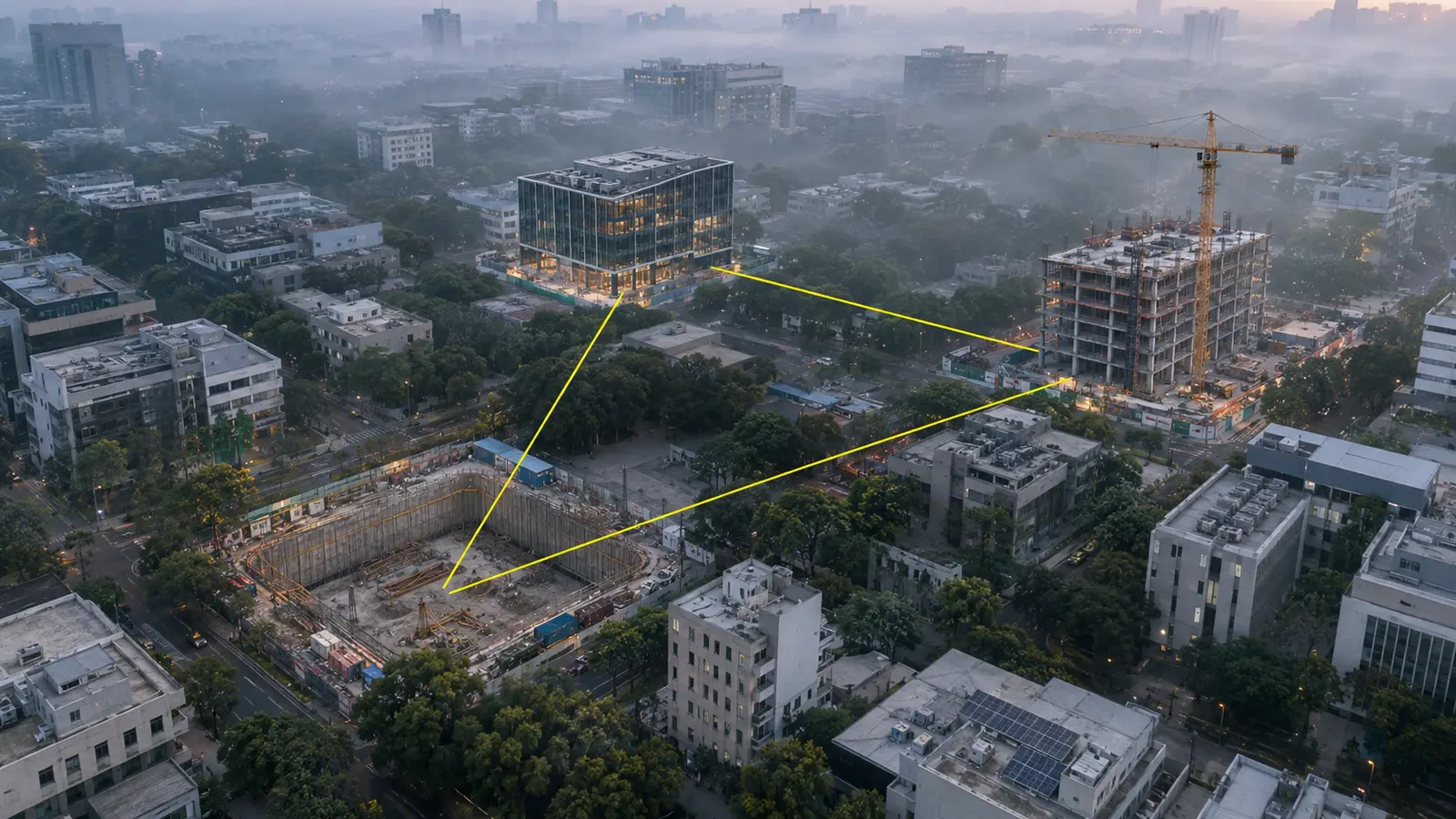
Construct IQ addresses that layer. Projects are captured by drone, 360° camera and fixed camera, and each capture is placed on the project timeline in DEX next to earlier ones. The portfolio monitoring with DEX use case applies identical capture parameters on every site and feeds them all into a single dashboard. The leadership team there can look over 10+ sites in half an hour, and disputes over billing dropped by 90 per cent. Because DEX exports progress reports to Procore, Autodesk and MS Project, the record joins the systems a company already runs instead of becoming one more silo.
Next steps for a leadership team
- Assess each function, from estimating to handover, against the five-stage model above.
- Pick one problem that costs measurable money and that the board already discusses.
- Record a baseline for it over at least a month.
- Name a senior owner from operations with authority to set standards.
- Redesign the process, then choose tools that support it and can export their data.
- Prove the change on two or three projects and compare results with similar projects.
- Write the new way of working into the standard project set-up.
- Review outcomes each quarter and retire tools that no longer earn their place.