
Key takeaways
- The Question: What can a drone roof inspection find on a commercial or industrial roof, and how do those findings turn into a repair plan?
- The Answer: A drone records the whole roof in one visit: ponding, torn or blistered membrane, open seams, blocked outlets, loose flashings and solar array faults, with a thermal pass for wet insulation. The result is a located, measured defect list that a roofing contractor can price and a facility manager can schedule, so people only go up where a hands-on check is needed.
- The YelloSKYE Angle: Inspect IQ captures roofs with RGB and thermal sensors while the building keeps running, and DEX keeps every roof survey on one timeline so each defect can be tracked until it is closed.
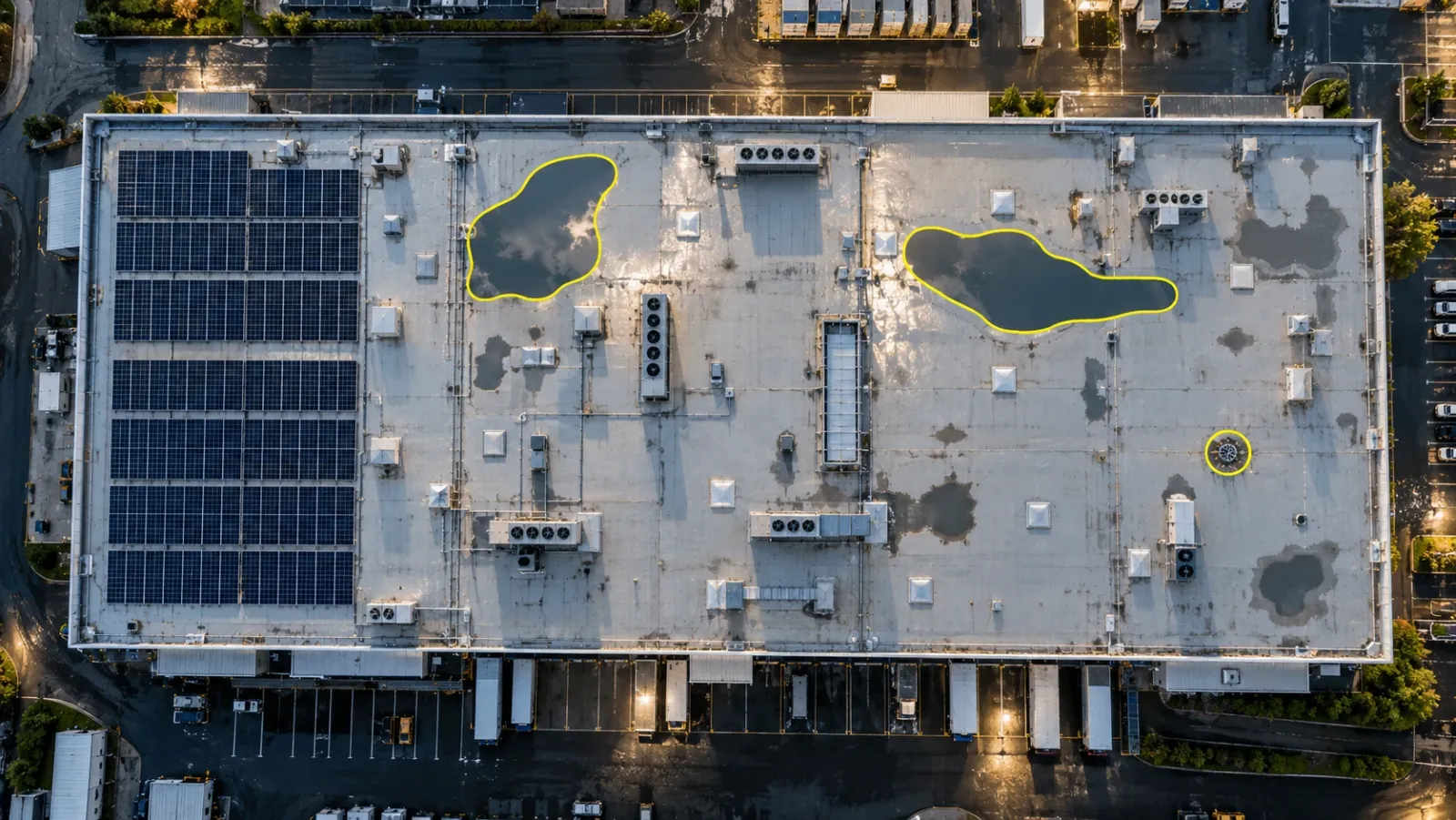
A drone roof inspection is a survey of a roof from the air, using high-resolution photographs and usually a thermal camera, to record its condition without anyone walking on it. On a large commercial or industrial roof it replaces a slow walk-over, or scaffolds and crawling boards on fragile roofs, with a complete and measurable record of the whole surface.
YelloSKYE carries out roof surveys through Inspect IQ, deploying RGB and thermal sensors over commercial facilities to locate water pooling, membrane tears and failing solar cells before they lead to leaks. This guide treats the roof as an asset to be managed. It covers what goes wrong on flat and metal roofs, how a survey is planned, what you should receive, how findings become a repair programme, and where a person still has to go up. How thermography works, and when its readings can be trusted, is explained in our guide to drone thermal inspection.
Why inspect a roof from the air
Large roofs are hard to inspect well on foot. A distribution warehouse or factory roof can cover several football pitches, and an inspector walking it sees a strip a few metres wide at a time. Coverage is patchy, and findings are recorded as notes and photos that are hard to place afterwards.
Walking a roof also carries risk and causes wear. Fragile rooflights and older fibre cement sheets are a known fall hazard, and foot traffic itself scuffs membranes and loosens laps. Meanwhile the building below usually has to keep working.
A drone survey changes the economics:
- Complete coverage. Every square metre is photographed, including areas nobody would walk to.
- A plan view that matches the drawings. The roof map can be read against the roof plan, plant layout and drainage design.
- No interruption. Inspect IQ captures data while the asset stays fully operational.
- A record you can compare. Each survey sits in the same coordinates as the last one, so change is visible.
In the automated asset inspection use case, replacing scaffolding and rope access with drone capture made inspections 10x faster.
What a drone roof inspection finds
Most roof leaks start at a small number of weak points: joints, junctions, outlets and anything that pierces the membrane. A survey is built around finding them.
| Defect | How it looks from the air | Best sensor | Why it matters |
|---|---|---|---|
| Ponding water | Standing water, or dirt rings and algae marking where water sat | RGB, ideally soon after rain | Adds load, ages the membrane faster and signals poor falls or blocked outlets |
| Membrane tears and punctures | Cuts, holes and scuffs, often near plant and access routes | Close RGB | Direct path for water |
| Failed seams and laps | Lifted edges, open laps, wrinkles along seam lines | Oblique RGB, thermal nearby | A frequent leak path on single-ply and bitumen roofs |
| Blistering and ridging | Raised bubbles or lines in the surface | RGB with low-angle light | Trapped air or moisture that can split the surface |
| Flashing and upstand defects | Detached or cracked flashing at parapets, plant kerbs, rooflights and pipes | Oblique RGB | Junctions are where roofs most often leak |
| Blocked drains and gutters | Debris, silt or plants around outlets, overflow staining | RGB | Leads to ponding and water overtopping into the building |
| Metal roof faults | Corrosion at laps and cut edges, missing fasteners, displaced sheets | RGB | Leaks and wind damage |
| Rooflight damage | Cracked, crazed or discoloured rooflights | RGB | Leak risk and a fall hazard |
| Wet insulation | Warm areas after sunset on a low-slope roof | Thermal | Hidden, spreads over time and drives repair scope |
| Solar array defects | Cracked glass, soiling, hot cells, displaced ballast, damaged cables | RGB and thermal | Lost output, and faulty connections can overheat |
Low-slope membrane roofs
Single-ply, built-up and modified bitumen roofs depend on continuous waterproofing and on water reaching the outlets. Ponding, open seams and damaged upstands are the main findings. Because the membrane sits over insulation, a puncture can let water spread a long way under the surface before anything shows inside. A thermal pass is what reveals that hidden spread.
Metal and profiled sheet roofs
Profiled metal roofs fail differently. The usual issues are corrosion at cut edges and side laps, fasteners that have backed out or rusted, sealant that has perished at end laps and ridge, and gutters that hold water. Oblique imagery along the laps and gutters matters more here than a thermal survey.
Roofs carrying solar panels
Rooftop solar adds both an asset and a blind spot. The panels need their own checks for hot cells, string faults, soiling and damaged cables, which follow the same thermal signatures used in YelloSKYE's solar farm thermal inspection work. The roof under the array also needs attention: mounting penetrations, ballast that has shifted, and cable routes that cross the membrane. Surveying both in one visit avoids paying twice for access and coordination.
Planning a drone roof survey
Start with the question and the records
Before any flight, collect what is already known: roof plans and build-up, previous inspection reports, warranty terms, and above all a log of interior leaks with their positions. Plotting leak locations onto the roof map later is one of the quickest ways to link a drip in the warehouse to a defect above it.
Permissions and coordination
Each country's national aviation authority (the FAA in the US, the UK's CAA and the UAE's GCAA are examples) sets the rules for commercial drone flights, and roofs close to airports or inside controlled airspace need clearance well ahead of the survey date. Tell the occupier when the flight will happen, agree a safe take-off area, and note any rooftop masts or equipment the pilot should keep clear of.
Timing
Different findings need different conditions, so a single visit is often split into passes:
- Visible survey soon after rain shows ponding and drainage problems clearly, provided the surface has dried enough to read seams and laps.
- Even daylight gives the best detail on membranes and flashings; low sun helps show blistering and ridging.
- Thermal survey needs a dry roof and an evening flight after a clear, sunny day, as explained in the thermal inspection guide.
Flight plan
| Capture | What it produces | Used for |
|---|---|---|
| Vertical grid of photos | A true-to-scale map of the whole roof | Locating, measuring and comparing defects |
| Oblique passes around the edge | Views of parapets, upstands, gutters and edges | Flashing and edge details |
| Close-up passes | Detailed images of seams, outlets, penetrations and plant kerbs | Diagnosing individual defects |
| Thermal grid | A temperature map of the roof and any solar array | Moisture extent and solar faults |
| 3D model | Roof geometry, falls and plant positions | Drainage review and repair planning |
The vertical grid is processed into an orthomosaic, a geometrically corrected map that can be measured; our guide to what an orthomosaic is explains how it is made.
What you should receive
A roof survey is only as useful as its deliverable. At minimum, expect:
- a measurable map of the whole roof, with the thermal layer aligned to it;
- a defect register in which each item has a location, an image, a description, a severity and a recommended action;
- measured areas and lengths for the larger defects, such as ponding zones, wet insulation and failed seam runs;
- the raw imagery, so a consultant or contractor can check any finding.
Inspect IQ reports list every defect with its coordinates, a marked-up image, a severity rating and suggested remediation, and can be exported as PDF or Excel or linked to a BIM model. In DEX, defects are tagged at their exact position on the captured roof, maintenance dashboards track open items and their severity across a portfolio of buildings, and the comparison view puts two survey dates side by side. The facade inspection from a desk use case shows the same habit applied to walls: measure the finding, compare dates, then decide whether access is needed.
Turning findings into a repair plan
A defect list running to hundreds of lines does not fix a roof. The step that matters is converting it into a programme of work that is priced, sequenced and checked.
Triage by consequence, not by count
Rank each finding by what it could cost if left: water entering above stock, production lines or electrical rooms comes first, followed by defects that will get worse with the next storm.
| Finding | Typical response | Urgency |
|---|---|---|
| Blocked outlet or gutter | Clear it and fit a guard | Immediate, and cheap |
| Open seam or tear above a recorded leak | Patch or re-weld | Before the next rain |
| Detached flashing | Re-fix and seal | Before the next storm |
| Hot connector on a rooftop array | Electrical repair by the solar maintenance team | Priority |
| Small area of wet insulation | Confirm with cores, then cut out and replace | Planned repair |
| Widespread wet insulation | Assess for overlay or replacement | Capital planning |
| Persistent ponding | Add outlets or tapered insulation; ask an engineer to check for deflection | Planned |
| Corroded laps on a metal roof | Treat and seal, or replace sheets | Planned |
Measure before you price
Because the roof map is to scale, ponding areas, wet insulation zones and seam lengths can be measured and handed to contractors as quantities. Tenders become comparable, and fewer surprises appear once the roofer is on site.
Group work by trade and by zone
Sort the register into packages: membrane repairs, drainage maintenance, solar maintenance, plant-related fixes. Then plan one access visit per zone rather than sending each trade up separately.
Decide between repair and replacement on evidence
When wet insulation covers a large share of a roof, patching becomes poor value. A thermal map confirmed by a few cores gives the owner a defensible basis for a replacement budget, rather than a contractor's estimate alone.
Close the loop
After repairs, capture the repaired areas again from the same viewpoints and compare the dates. The before-and-after record shows the work was done, supports warranty and insurance conversations, and becomes the baseline for the next survey.
When someone still has to go up
A drone survey decides where and why people go onto the roof. It does not remove the need entirely.
- Confirming wet insulation. Cores or moisture meters should verify thermal findings before large areas are cut out.
- Probing seams. A seam can look closed from the air and still be unbonded; only a physical check finds that.
- Fixings and uplift resistance. Fastener security, edge details and ballast need hands-on testing.
- Hidden areas. Ground under solar panels, plant and walkways is partly or wholly out of the camera's view.
- The underside. Deck condition and the actual drip points are inside the building.
- Electrical testing. Suspected solar faults are confirmed with electrical tests.
- Warranty inspections that the manufacturer requires to be attended in person.
- The repairs themselves, with proper edge protection and access arrangements.
The difference is that the people who go up arrive with a marked position, a measured scope and an earlier image to compare against.
Roof inspection checklist
- Gather roof plans, previous reports, warranty terms and a log of interior leak positions.
- Confirm airspace permissions and notify the occupier.
- Plan a visible pass soon after rain and a thermal pass on a dry evening after a sunny day.
- Fly a vertical grid for the roof map, plus oblique and close-up passes for edges, outlets and penetrations.
- Include any rooftop solar array and the membrane beneath it in the same visit.
- Ask for a located, measured defect register with severity and recommended actions.
- Rank findings by consequence, confirm the serious ones on site, and group work by trade and zone.
- Re-capture repaired areas and keep every survey on one timeline for the next comparison.