Data Center Construction Labor Shortage: Why Skilled Crews Run Short and How Teams Cope
By Kush Agarwal, President and CEO, YelloSKYE. Published .
Executive Summary
- The Question: Why do data centre projects keep running short of skilled people, and what can a project team do about it before the next hall is due?
- The Answer: Data centres need a concentrated burst of electrical, controls and commissioning skill, often in regions where several campuses are being built at once. The shortage cannot be fixed by hiring mid-project, so teams protect the hours of the people they have: more work built in factories, fewer trips for specialists, better-prepared work areas and verification done from a shared record.
- The YelloSKYE Angle: Construct IQ gives distant specialists and site leaders one dated view of the campus built from drone flights, fixed cameras and 360° walks, so fewer decisions wait for someone to travel. YelloSKYE has no data centre case study; these are methods we apply on other complex buildings.
Data centre projects run short of skilled labour because they need an unusually large amount of electrical, mechanical, controls and commissioning work, compressed into short programmes and concentrated in a handful of regions. Experienced electricians, cable jointers, controls technicians and commissioning engineers take years to train, and the same people are wanted by grid, energy and industrial projects at the same time. The result is not usually an empty site but a series of small waits that push risk towards the end of the job.
Most teams cannot hire their way out of this within a single build. What they can do is make every skilled hour count. This guide explains which skills run short, how the gap shows up in the schedule and the practical ways contractors and owners stretch the crews they have. It draws on how Construct IQ, YelloSKYE's construction monitoring service, supports remote verification on other complex projects. If you need the stages of a build first, read how the data centre construction process runs from power and land to commissioning.
Which skills run short
General labour is rarely the bottleneck. The gaps sit in roles that combine a licence or certification with experience of mission-critical systems.
| Role | What they do on a data centre | Why they are scarce | What happens when they are missing |
|---|---|---|---|
| Electricians | Install and terminate switchgear, busway, distribution boards and cabling to every rack row | Long apprenticeships, licensing, heavy demand from energy and grid work | Rooms with equipment set but not connected |
| High-voltage jointers | Joint and terminate medium-voltage cables to transformers and substations | Small workforce with specialist certification | Energisation dates slip |
| Controls and BMS technicians | Wire, programme and test monitoring and building management systems | Blend of electrical and software skills | Systems installed but not ready to test |
| Pipefitters and welders | Build chilled water and liquid cooling pipework | Certified welding on clean, pressure-tested systems | Cooling loops late for flushing and testing |
| Commissioning engineers | Plan and run start-up, functional and integrated tests | Few people have run tests on critical power and cooling | Test windows compressed or deferred |
| Experienced supervisors | Sequence trades and release work areas | Knowledge built over several previous builds | Crews arrive at areas that are not ready |
Operations face a similar problem. Uptime Institute's annual surveys of data centre operators have reported for several years that many struggle to recruit and keep qualified staff, and construction and operations often draw on the same pool of electrical and controls talent.
Why data centres feel the shortage more than other buildings
Every sector is competing for skilled trades, but several features of data centre work make the competition sharper.
The skill mix shifts towards the specialist end
On an office or residential project, structure and finishes take a large share of the labour. On a data centre, the shell goes up relatively quickly and then the project becomes overwhelmingly electrical and mechanical. Demand for licensed trades rises steeply just as the programme reaches its most critical phase.
Campuses cluster
Operators look for the same things: available power, fibre, land and supportive planning. Several campuses often end up in the same region, all mobilising electrical crews within a few months of each other. Local supply runs out quickly, and the rest comes from travelling crews.
Phases compete with each other
A large campus is delivered building by building. The crew finishing hall one is the same crew the next phase is counting on, so a slip in one building borrows people from the next.
Commissioning is a narrow speciality
Integrated testing of power and cooling, including simulated failures and load bank tests, needs people who have done it before. There are not many of them, and they are usually booked across several projects at once.
Travelling crews arrive without history
Agency and travelling labour fills gaps, but new arrivals do not know the project's naming, sequence or past problems. Every rotation costs supervisor time in briefing, and knowledge leaves when the crew moves on.
How the shortage shows up in the schedule
A labour shortage rarely appears as a single missed date. It shows up as symptoms that each look minor in a weekly report.
| Symptom | Where you see it | Knock-on effect |
|---|---|---|
| Plant set but not connected | Electrical rooms, UPS and switchgear areas | Start-up testing waits, and later trades pile up behind |
| Areas released late, crews idle | Halls where a prior trade has not finished | Skilled hours paid for with nothing to install |
| Overtime becomes routine | Timesheets on the critical electrical scope | Fatigue, more errors and more rework found at testing |
| Crews moved between buildings | Multi-phase campuses | One building's recovery becomes another's delay |
| Specialist decisions waiting for a visit | Design queries, readiness checks, owner sign-offs | Days lost while someone arranges travel |
| Defects found late | Functional and integrated tests | Rework at the point with the least float left |
The common thread is that the scarce person spends time on the wrong thing: waiting, travelling, re-checking or redoing. That is where teams find room to recover.
How teams stretch the crews they have
None of the measures below creates new electricians. Together, they let the same people install more, wait less and redo less.
Build more of the work in factories
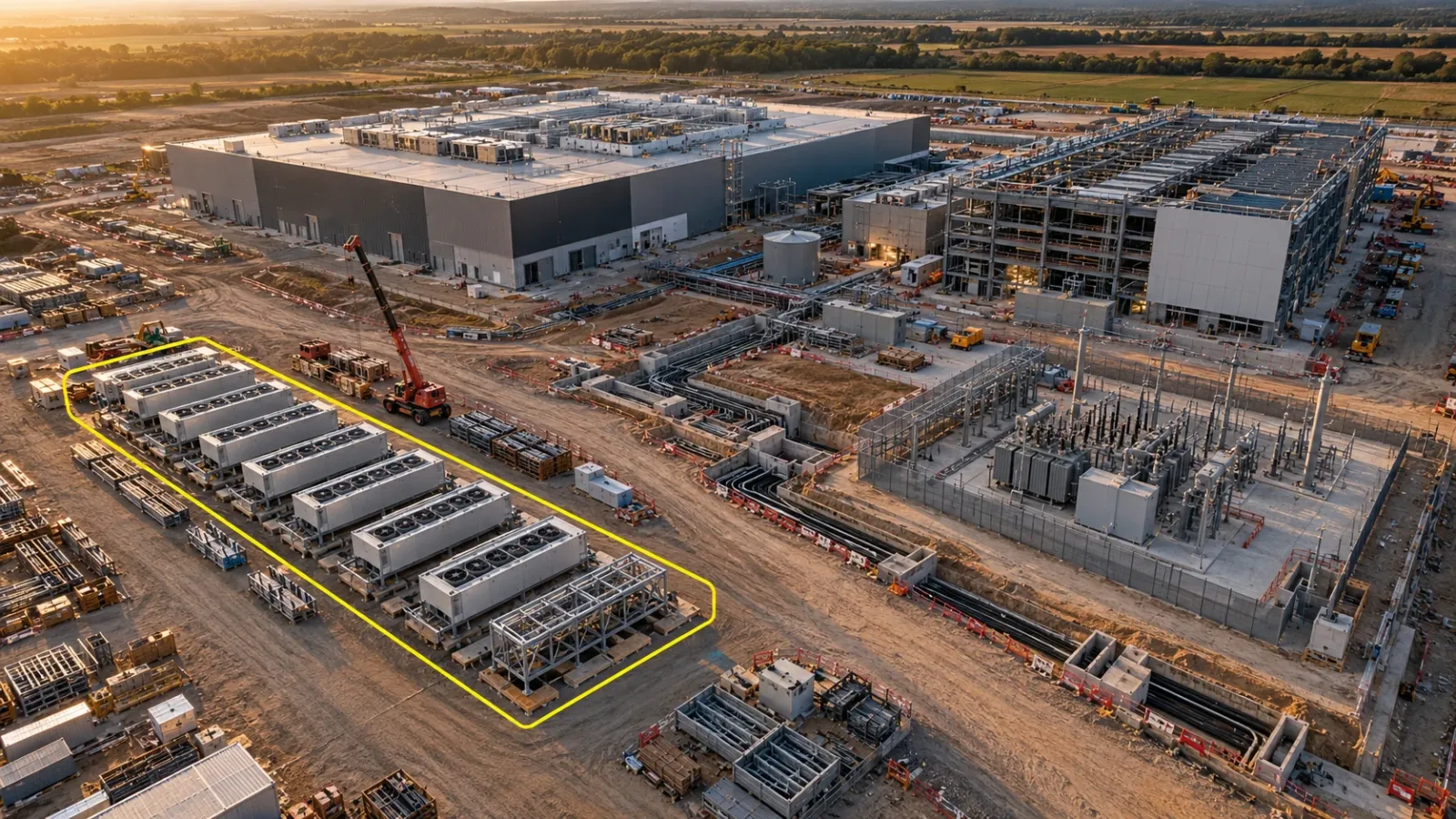
Prefabrication is the biggest lever. Electrical rooms can be built as self-contained modules with switchgear, distribution and controls already installed and tested. Generators, cooling units and pumps can arrive skid-mounted. Cable tray, busway and pipework can be pre-assembled into racks that are lifted into place.
This moves hours into a controlled environment where work is easier to supervise, inspect and test. Factory testing also takes some of the load off site commissioning, because each module arrives with its own test records.
Prefabrication shifts risk rather than removing it. Modules only save time if the site is ready for them: plinths in the right place and at the right level, routes clear and connection points where the design says. A misplaced plinth or sleeve found when a crane is already booked costs more than the hours the module saved. Checking that setting-out matches the model before modules arrive, for example by laying a laser scan over the design model as the as-built versus BIM clash detection workflow does, protects the investment.
Verify remotely instead of travelling
Designers, commissioning managers, package leads and owner's representatives are often responsible for several sites. Every trip to confirm whether a room is ready, a route is clear or a query is real takes a day or more out of their week.
A shared, dated record of the site changes that. Drone flights show campus-wide progress, fixed cameras show what is happening in priority zones between flights, and 360° walks show interiors room by room. Specialists can answer most readiness questions from their desks and keep their site time for witness tests and inspections that genuinely need them there.
Plan specialist trips around decisions
When travel is needed, make it count. Group witness tests and inspections into the same visit, send the relevant captures ahead so the visitor arrives knowing what to look at, and agree in advance what will be signed off. A visit that ends with a decision is worth several that end with a follow-up email.
Make sure work areas are ready before crews arrive
A skilled crew standing in an unready room is the most expensive kind of waste. Before releasing an area to the electrical or mechanical crew, check that the previous trade has finished, materials are on site, access is clear and drawings are current. A dated walk of the area at handover between trades gives both sides the same evidence of its condition. Our guide to construction coordination covers lookahead planning and area release in more detail.
Split tasks by skill level
Not every hour of electrical work needs the most experienced electrician. Where local rules allow, semi-skilled workers and apprentices can install containment, pull cable and fix supports under supervision, leaving licensed electricians to terminate, test and sign off. The same principle applies to supervisors: if they spend hours compiling progress reports, that is time not spent sequencing the work.
Keep the project's memory when people rotate
Crews and supervisors change during a long build. A navigable record of the site, organised by hall and room, lets a new arrival see how an area was built, what changed and where open issues sit, without a long walk with someone who is already stretched. It also helps commissioning engineers trace a fault without opening finished work.
Measuring whether it is working
If a team is trying to do more with the same crews, track where the skilled hours go.
| Measure | What to track | Good direction |
|---|---|---|
| Workface readiness | Share of areas fully ready on the day a skilled crew is due to start | Rising |
| Waiting time | Hours booked by skilled trades with no workable area or material | Falling |
| Specialist trips | Site visits by designers, commissioning staff and owner's representatives each month | Falling, with more decisions per visit |
| First-time pass rate | Share of start-up and functional tests passed on the first attempt | Rising |
| Prefabricated share | Proportion of electrical and mechanical scope built off site | Rising, where design allows |
| Query turnaround | Days from a site query to a decision | Falling |
Review these at the same rhythm as the programme, building by building. A campus that improves readiness in one hall can usually carry the lesson into the next.
Where YelloSKYE fits
YelloSKYE has not delivered a data centre case study, so we do not claim results on this building type. Construct IQ offers the capture methods discussed in this guide, and we apply them today on other large, complex sites.
- Drone capture gives a site-wide, dated view of external works, plant yards and shells. In the aerial progress capture use case, regular flights gave site managers back 15 or more hours every week, which is exactly the kind of supervisor time this guide is about protecting.
- Fixed cameras record chosen zones from the same position between flights, and DEX sends a notification if work stops in a zone marked as high priority. Used together with DEX, they have reduced site visits by as much as 80 per cent in verified YelloSKYE deployments; the fixed-camera construction monitoring use case explains the set-up.
- 360° walks of interiors need no specialist operator; anyone on the site team can do them, so the record keeps up with the work even when skilled people are scarce.
- Laser scanning through BIM IQ compares installed geometry with the design model, which helps confirm that plinths, routes and penetrations are ready for prefabricated modules.
On DEX, captures sit on one timeline, Time Travel Playback steps back through a room's history day by day, and actual progress is overlaid on the planned 4D schedule so slippage stands out. For campuses with several buildings, data centre construction progress tracking explains how to organise that record hall by hall.
A checklist for the next data centre bid
- Map the skills. List the licensed and specialist roles the programme needs month by month, and compare the peak with what the region can supply.
- Decide what to prefabricate early. Choose modules and racks during design, not after the labour plan fails.
- Check the site before modules arrive. Verify plinths, levels, sleeves and routes against the model ahead of each delivery.
- Set up a shared visual record at mobilisation. Agree capture methods, cadence and access rules with the owner, including any restrictions in secure areas.
- Define area readiness. Write down what must be true before a skilled crew starts in a room, and capture the room at each handover between trades.
- Plan specialist visits around decisions. Group witness tests and send the evidence ahead.
- Separate skilled and supporting tasks. Assign work by skill level where rules allow, and free supervisors from manual reporting.
- Track skilled hours. Measure readiness, waiting time, trips and first-time pass rates, and review them for every building on the campus.
Frequently asked questions
Why is there a shortage of electricians for data centre construction?
Data centres need far more electrical work than most buildings, and the demand arrives in short, intense bursts on sites that tend to cluster in the same regions. The same electricians are also wanted by grid upgrades, renewable energy schemes and industrial plants. Training a licensed electrician who can lead a crew on critical power takes years, so supply cannot catch up within a single project.
Which roles are hardest to fill on a data centre project?
Experienced electricians and cable jointers, controls and building management system technicians, and commissioning engineers are usually the scarcest. Supervisors who have delivered a data centre before are also hard to find, because they hold the sequencing knowledge that keeps several trades productive at once. General labour is rarely the constraint.
How does a labour shortage affect a data centre schedule?
It rarely shows up as an empty site. More often electrical rooms sit with equipment set but not terminated, commissioning windows get compressed, crews are moved between buildings and travelling workers arrive without knowledge of the project. Each of these pushes defects and delays towards integrated testing, where there is the least float left to absorb them.
Does prefabrication reduce the need for skilled labour on site?
It reduces it on site, and that is usually the point. Prefabricated electrical rooms, skid-mounted plant and pre-assembled pipe and cable racks move hours into factories where work is easier to supervise and test. Site crews still make the final connections, so the site has to be ready, with plinths and routes in the right place, when the modules arrive.
Can remote monitoring replace site visits by specialists?
It can replace many routine visits, but not all. Designers, commissioning managers and owner's representatives can review dated drone, fixed-camera and 360° records to check readiness and progress without travelling. Witness tests, final inspections and anything that needs hands on the equipment still need people on site, so the aim is to reserve their trips for those moments.