Builder's Risk Insurance Claims: How the Process Works and the Evidence That Speeds It Up
By Kush Agarwal, President and CEO, YelloSKYE. Published .
Executive Summary
- The Question: After fire, storm, water or theft damages a project insured under builder's risk or contractors' all risks (CAR), what decides how quickly and how fully the claim is paid?
- The Answer: The insurer has to be satisfied that physical damage happened during the policy period, that its cause is covered, what the damaged work was worth and that the policy's conditions were being kept. Claims move fastest when the contractor can answer all four from records made before and immediately after the event.
- The YelloSKYE Angle: Construct IQ keeps a dated drone, 360° and fixed-camera record of the whole site on the DEX platform, so the condition before the loss, the damage itself and the repair can all be shown from one place.
A builder's risk claim asks the insurer of the works to pay for damage to, or loss of, a building that is still being built. In North America the cover is usually called builder's risk; in many other markets the equivalent is contractors' all risks (CAR), or erection all risks where plant and machinery are being installed. Whatever the name, the claim runs through the same stages: notify, make safe, inspect, quantify, settle. How long each stage takes depends mostly on evidence. This guide walks through those stages, the points where claims usually stall and the site records that keep them moving, with examples from how Construct IQ, YelloSKYE's construction monitoring solution, records a site.
This is general guidance, not insurance or legal advice. Policy wording varies a great deal between insurers and markets, so check how your own policy treats each point with your broker.
One cover, two names
The two share a purpose but are often packaged differently, which decides whether a given loss belongs to this policy or another.
| Builder's risk (usual in North America) | Contractors' all risks (usual in many other markets) | |
|---|---|---|
| What is insured | The building under construction and materials meant to become part of it, often including materials stored off site or in transit | The contract works and materials, often temporary works, with optional cover for plant and equipment |
| Liability to others | Normally bought separately, under general liability | Often included as a second section of the same policy |
| Who usually arranges it | The owner or the general contractor, as the contract requires | Often the main contractor, in the joint names of the contractor, owner and subcontractors |
| Basis of cover | Usually all risks less exclusions; some forms list named perils | All risks less exclusions |
| Common add-ons | Soft costs, delay in opening, testing | Delay in start-up (also called advance loss of profits), extra charges for express repairs |
In the rest of this guide, "the policy" means whichever of the two covers your works.
What the insurer has to establish
Every claim, small or large, comes down to a handful of questions that the adjuster (called a loss adjuster in many markets) must answer before the insurer pays. Knowing them in advance shows you exactly which records will matter.
| The insurer's question | Why it matters | Records that answer it |
|---|---|---|
| Did insured property suffer physical damage during the period of cover? | No physical damage, or damage before cover started, means no claim on this policy | Dated captures from before and after the event |
| What caused it, and is that cause covered? | Policies exclude some causes, such as defects, wear or gradual deterioration | The condition of the work before it failed; the sequence of events on the day |
| What existed at the moment of loss? | The insurer pays for work in place, not work planned | Progress records and quantities at the last capture before the event |
| Were the policy's conditions being kept? | Many policies make cover depend on protective measures | Records of security, fire protection and water controls as they stood at the time |
| What is a fair cost to put it right? | Settlement is based on reasonable reinstatement cost | Measured extent of damage, repair method and costed estimate |
Most delays happen because one of these has no clear answer and someone has to reconstruct it.
The claim from first call to settlement
1. Give notice early, even if the picture is incomplete
Policies typically require notice "as soon as practicable" or within a set period. Notify the broker and insurer as soon as you know of a loss that could reach the deductible, with the facts you have. A short, early notice is better than a full one that arrives late, because late notice is itself a reason insurers can use to reduce or refuse a claim.
2. Make safe and prevent further damage
Most policies place a duty on the insured to take reasonable steps to stop the loss getting worse: covering an opening, pumping out water, securing loose panels. The cost of these steps is often recoverable. Record the damage before you move anything, then record what you did to protect the site. Clearing debris before the damage is captured is one of the most common ways to weaken a claim without realising it.
3. The adjuster's inspection
The insurer appoints an adjuster who will want to see the damage, understand the cause and agree a scope of repair. The adjuster may spend only a few hours on a building they have never seen. Showing the same area on dates before the event, side by side with the damage, answers many questions in the first meeting rather than over weeks of correspondence.
4. Quantify the loss
Quantification turns damage into money: removal, replacement materials, labour, temporary works, fees and any covered extra costs. Arguments usually start where the claim and the adjuster's view of "what was there" differ. A record that shows how far each element had progressed at the last capture before the loss narrows that gap.
5. Submit the claim or proof of loss
In North America this is often a formal, signed proof of loss within a deadline set by the policy. Elsewhere it is usually a claim submission with supporting documents. The more of it that points to dated, located records rather than descriptions, the fewer follow-up questions it attracts.
6. Interim payments and settlement
On large losses, insurers often make interim payments while repairs continue. Each interim payment needs evidence that the repair work claimed has been done, which is the same kind of proof as a progress payment claim.
7. Reinstatement and close-out
Capture the repaired area once the work is finished. That record closes the claim, shows the works were restored and becomes the new baseline if the same area is damaged again.
Where claims stall
The condition before the loss cannot be shown
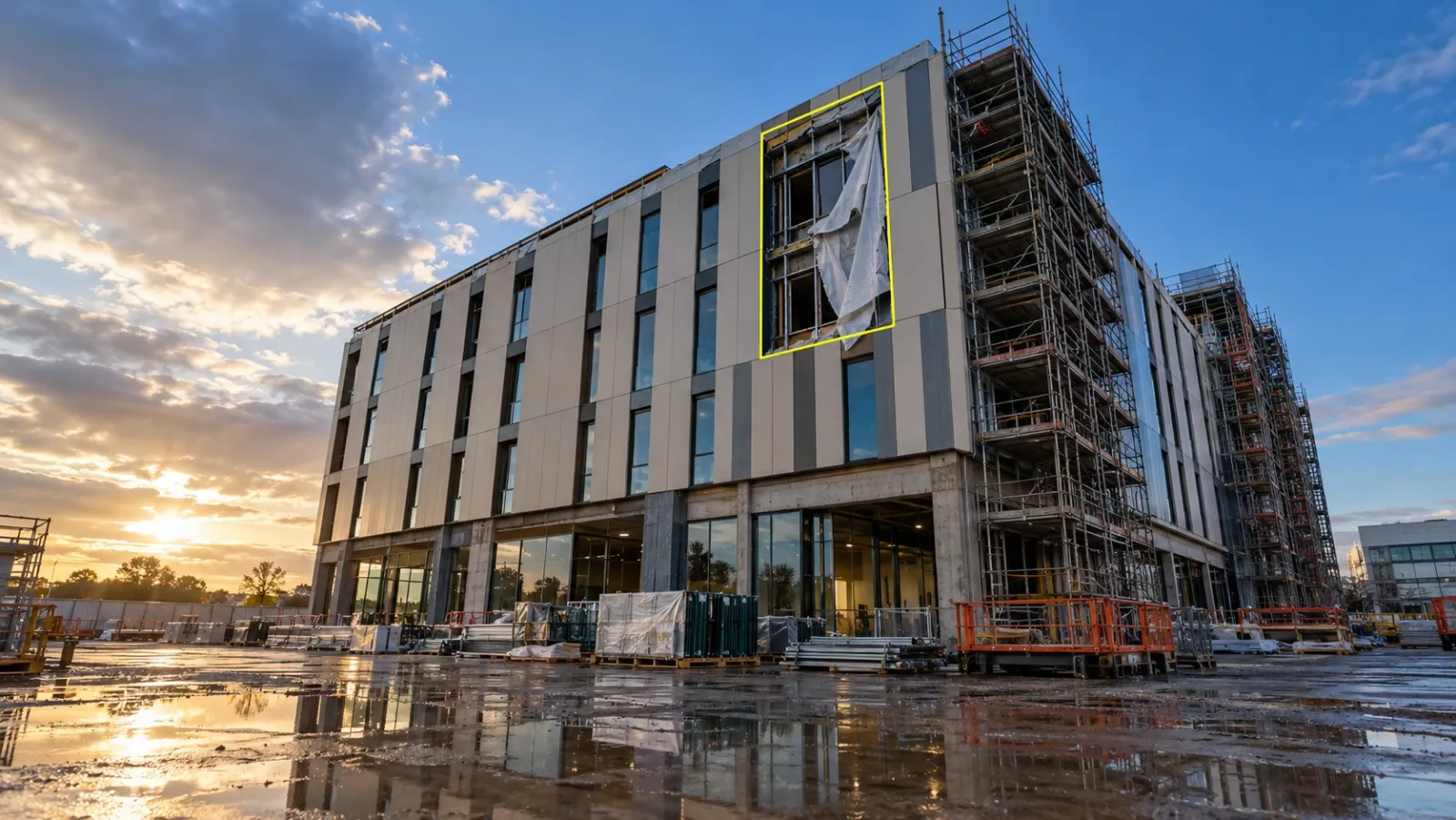
The most common problem is the simplest. A storm tears off cladding, and the contractor says twelve bays were complete; the adjuster's notes suggest eight. Without a dated record of the facade before the storm, the claim is settled on the lower figure or argued for weeks.
Damage and defect are tangled together
Policies generally pay for damage but not for putting right work that was faulty in the first place. CAR policies in many markets use the London Engineering Group (LEG) defect clauses to draw that line, and builder's risk forms carry similar exclusions for faulty workmanship, often with cover for the damage that results. When a pipe joint fails and floods a floor, the joint itself may be excluded while the flooded finishes are covered. Records of the installation before it was concealed help the adjuster separate the two fairly.
A policy condition cannot be proved
Many policies attach conditions to cover, sometimes called warranties or subjectivities: a fire protection plan, hot works permits, perimeter security, water leak detection, a flood response plan. After a loss, the insurer may ask whether those measures were in place on the day. Teams usually photograph finished work, not the fence line or the fire extinguisher points, so this is often where evidence is thinnest.
Two events blur into one
Deductibles usually apply to each occurrence. If two storms hit a week apart, or water damage happens in stages, the insurer needs to know which damage came from which event. A capture between the two events settles it.
Stored materials cannot be counted
Theft and damage in laydown areas raise a simple question: how much was there? Delivery notes show what arrived, not what was still on site the night before.
Evidence by type of loss
| Loss type | What the adjuster will ask | Records that help |
|---|---|---|
| Fire | Where did it start, how far did it spread, were fire precautions in place? | Captures of the affected floors before the fire; records of extinguishers, hot works areas and housekeeping |
| Wind and storm | Which elements were complete and fixed, and which were temporary? | Facade and roof captures before the storm; post-storm aerial survey of the whole site |
| Escape of water | Where did the water come from, when, and was the system being tested? | Services captured before concealment; dated record of the area as water spread |
| Flood and surface water | Was the site prepared, and how high did the water reach? | Terrain and drainage records; captures of the site before and after the event |
| Theft and vandalism | What was on site, and was the site secured? | Fixed-camera images of the laydown area and gates; perimeter condition at the last capture |
| Damage linked to a defect | Which part was defective, and what damage followed? | Records of the installation before it was covered |
Building the record before anything happens
The evidence that decides a claim has to exist before the loss. Nothing captured afterwards can show what the site looked like the day before.
Capture the whole site on a fixed rhythm
A regular, complete capture of the site means there is always a recent "before" image of any area. Gaps in time or coverage are where adjusters' questions go unanswered. Our guide to construction photo documentation sets out what to capture at each stage.
Record the protective measures as well as the work
Add the things the policy cares about to the capture plan: hoarding and gates, fire points, hot works areas, temporary weather protection, pumps and leak detection. If your policy lists conditions, turn each one into something that appears in the record.
Tie the record to value
The progress record you use for payment claims is also the best evidence of work in place at the moment of loss. Captures timed to each progress payment claim give you a quantity and a value on a known date. Our aerial progress capture use case describes a weekly drone programme run in exactly this way.
Keep the record off site
If the site office burns or floods, records kept on its computers go with it. A cloud-hosted record survives the event it has to prove.
Agree who shares what
Decide at the start who will deal with the insurer after a loss and which views of the record they will share. Disputes between trades rely on the same kind of record, as our guide to construction dispute documentation explains.
Where Construct IQ fits
Construct IQ builds this record with several sensors, each covering a different kind of loss:
- Drone surveys fly pre-programmed routes on a regular schedule, so each capture of the roof, facade, stored materials and site boundary can be compared with the last. An extra flight after a storm shows the whole site in one dataset.
- 360° walks record interiors room by room, including services before ceilings and walls close, and any site worker can carry them out.
- Fixed cameras take timestamped images of selected zones, such as laydown areas, access points and tower faces, at agreed intervals between flights. Our fixed-camera construction monitoring use case shows how they fill the gaps between drone missions.
- The DEX platform holds it all as one record. Time Travel Playback scrolls through site history day by day, captures from two dates can be compared, and distance, area and volume can be measured from a desk. Issues are tagged where they were seen, DEX keeps immutable logs intended for resolving disputes, and role-based access controls who sees which part of the record.
For facade damage specifically, the Facade view in DEX shows each side of a building as a map for a chosen date, with two dates side by side and measuring tools, as described in our facade inspection from a desk use case. Set-up and the first capture take 48 to 72 hours on most projects.
How documentation affects underwriting, premiums and loss history across every policy on a project is covered in our guide to jobsite documentation and insurance.
A practical checklist
Before a loss
- Read the policy's conditions with your broker and list what each one requires on site.
- Add those protective measures to the capture plan, alongside the work itself.
- Capture the whole site on a fixed rhythm, with at least one capture before each progress payment claim.
- Keep every capture dated, located and stored off site.
- Name the person who will notify the insurer and manage the claim.
In the first days after a loss
- Make the site safe and notify the broker and insurer.
- Capture the damage across the whole affected area before anything is cleared.
- Record every step taken to stop further damage, and keep the costs.
- Pull the last captures before the event for every affected area.
- Prepare a short pack for the adjuster: before, after, protective measures and quantities.
- Agree permanent repairs with the insurer before starting, and capture the area again when they are complete.
Frequently asked questions
What is the difference between builder's risk and contractors' all risks insurance?
Both insure the works while they are being built against physical loss or damage. Builder's risk is the usual name in North America and normally covers the property only, with liability bought under a separate policy. Contractors' all risks (CAR), common in many other markets, often adds a third-party liability section to the same policy. The claims process for damage to the works is broadly the same under both.
What does a builder's risk claim need to include?
Insurers generally need prompt notice of the loss, a description of what happened and when, evidence of what the damaged work looked like before the event, the extent of the damage, a costed estimate to put it right and proof that the policy's conditions were being met. Dated site records made before and straight after the event answer most of these questions directly.
How long does a builder's risk claim take to settle?
It depends on the size of the loss, how clear the cause is and how quickly the insured can answer the adjuster's questions. Small, well-documented losses can close quickly, while large or disputed ones can take many months. Missing evidence of the pre-loss condition and arguments over cause are the most common reasons for delay.
Why are builder's risk claims reduced or declined?
Common reasons include damage caused by an excluded cause such as faulty workmanship or wear, a policy condition that was not met or cannot be shown to have been met, late notice, and a loss that cannot be separated from damage that already existed. Many of these come down to evidence rather than cover. Your broker can explain how your own wording treats each one.
Can repairs start before the insurance adjuster visits?
Most policies expect you to make the site safe and prevent further damage straight away. Permanent repairs are a different matter, so agree them with the insurer or adjuster first. Either way, record the damage thoroughly before anything is moved, because once it is cleared it cannot be shown again.